
By Iain Dupont
The tradition of inspecting and walking the ‘marches’ or boundaries of our burgh, likely go back to the beginnings of our burgh in the twelfth century. However due to the ravages of time, and the great events Stirling has been caught up in, our burgh records do have their gaps.
As such our earliest record of the Walking the Marches can be found in, The Records of the Burgh of Stirling; dated 18th March 1611, which;
“Statutes and apointes ane visitatioune of the tounes merches to be yeirlie on the Monday nixt and immediatlie following the electioun and admissioun of the provest, baillies and counsall, and on the Monday nixt eftir the feist of Peashe, yeirlie”
Over 400 years later, we are still commemorating this inspection of the marches.
In the days before our celebration, a group of volunteers, known as the birlawmen walk the boundaries of the town, to inspect the march stones and turn over a sod of earth to mark their inspection.
It is the successful completion of this inspection that we celebrate, and it is the core of our entire celebration of Stirling and its heritage.
It does beg the question though, why are the march stones inspected and what makes them so important?
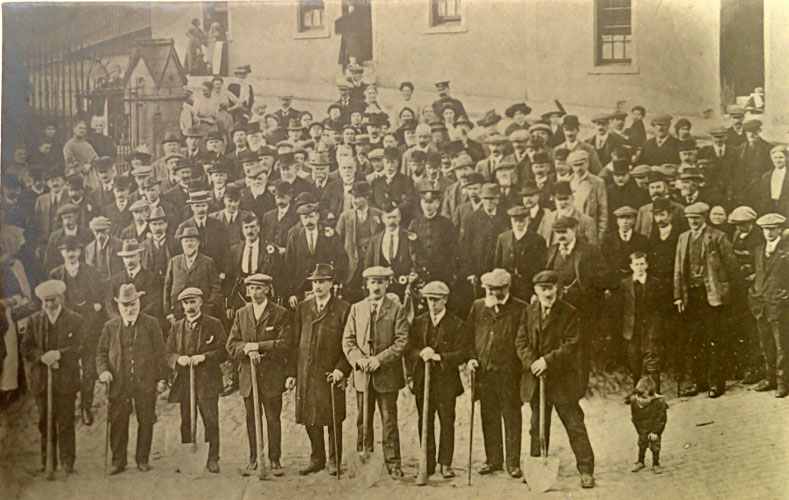
The 1911 Walking of the Marches, with the Birlawmen in the foreground.
To understand this, we need to go back to the origins of all of Scotland’s burghs, and their original purpose.
The first burghs were established in Scotland by King David I. David had spent much of his early life in the royal court of England. When he became king of Scotland, he wanted to introduce knights and castles to Scotland, as the Norman kings had in England.
These sweeping changes however did not come cheap, and so David needed a good source of money and resources.
This is where burghs came in. Burghs had been the main trading centres in England for centuries at this point. They were often the only communities in their area where trading could legally take place, and so were often home to the workshops and houses of merchants and craftsmen. All this craft and trade was profitable, and so the kings would of course receive taxes from all the trade and work in the burghs.
David I began to quickly set up in existing communities and on new sites across the east coast of Scotland, from Roxburgh in the south, to Inverness in the north.

An illustration of David I from a charter of Kelso Abbey, dated 1159. Source: Wikipedia
To ensure these communities could trade and prosper in peace, they were given a legally defined area in which burgh law applied. This meant that the community of the burgh, the burgesses, could defend their livelihoods in a court of law, rather than having defend themselves through force of arms. This area around the burgh was also vital for supplying raw materials for the burgh, from wood for fuel and building, to fish and grain for trading and eating. This area, or hinterland however needed to be clearly identified, so that other communities could not exploit the burgh’s resources, or take land from them.
This is where the march stones came in. The stones were placed at the boundaries of the burgh’s hinterland to clearly mark where burgh law applied, and where the burgesses could take materials from.
Over time as the burghs grew, they would have to expand their hinterland, to provide more for the growing community, and so as the boundaries shifted, the march stones moved with them.
To ensure the boundaries were up to date or that they hadn’t been moved by angry neighbours who might have lost land, the men of the town would annually walk the boundaries. They would inspect the march stones, ensuring that they hadn’t been moved or damaged.
Over the centuries this act of civil duty became a key part of maintaining a community’s identity and a celebrated tradition for many burghs.
Stirling was no exception, and in time began to celebrate each successful perambulation, with a parade through the burgh.
The perambulation and parade are the cornerstones of our modern Walking of the Marches.
The March Stones, the Perambulation, and the Parade are not just reminders of our past, but are also celebrations of the all the journeys and stories that led to the burgh of Stirling we see today.
So why not join us in taking the next steps in Stirling’s journey and celebrate YOUR Walking of the Marches with us?